Tree removal is the safe cutting down and hauling away of a tree that’s dead, diseased, storm-damaged, or too close to a structure to leave standing. 770-Tree-Guy provides tree removal across Sharpsburg, Newnan, Peachtree City, Fayetteville, and the surrounding South Metro Atlanta communities, with two locations positioning our crews to respond quickly across Coweta, Fayette, and Clayton counties.
Every removal is handled by a licensed, insured crew with two ISA Certified Arborists and NCCCO certified crane operators, backed by 16 years in business and crew experience going back to 2004.
Request a free estimate: call (770) 373-4438, usually available the same day. For a whole-lot project, see our lot clearing services.
Remove or Trim: How to Tell the Difference
Removal is the right call when the problem is structural, not cosmetic: the tree is dead or more than half the canopy is dying, the trunk is split or hollow, it’s leaning after a storm, disease could spread, or roots threaten a foundation. If pruning solves it instead, we say so during the estimate, even though a trim job pays less. For canopy maintenance rather than a hazard, see tree trimming and pruning.
Warning Signs: When a Tree Needs Professional Removal
- Dead or hanging limbs throughout the canopy
- Cracks or splits along the trunk
- A new lean, especially after heavy rain
- Mushrooms or fungal growth at the base
- Exposed or heaved roots
- Limbs over the roof or on power lines
- Sparse, discolored foliage in the growing season
- Cavities or soft, punky wood in the trunk
Catching these early is often the difference between a routine removal and an emergency one.
Storm Risk in South Metro Atlanta: Why Emergencies Happen Between Storms
The clay-heavy soil from Coweta County through Fayette and into Clayton County holds water long after heavy rain, weakening root systems. That’s why a loblolly pine in Peachtree City or a Jonesboro backyard can fail in wind that normally wouldn’t bring a tree down. A tree that survives one storm standing at a new angle is often one gust from coming down, which is our most common call after a front passes through. The Georgia Forestry Commission’s storm-damage guide is a solid second opinion for assessing a leaning tree.
Why Hire a Professional: What’s at Risk with an Amateur Crew
Large sections can fall unpredictably, and internal decay hides real structural weakness. OSHA’s Tree Care Industry data documents how often falls, struck-by incidents, and electrical contact injure untrained crews, which is why ours train against those hazards specifically. A certified crew brings the right rigging for tight lots, protects nearby structures, hauls debris completely, and gives an honest read on the tree’s condition before the first cut.
Certifications That Matter: What to Verify Before You Hire
ISA Certified Arborists
Two on staff, plus the ISA Qualification in Tree Risk Assessment: the credential for judging whether a tree is safe to leave standing.
TCIA Accreditation
Sets the safety and business standards our crews operate under, from equipment to job-site protocols.
NCCCO Certified Crane Operators
A certification that smaller companies often skip. It matters the moment a crane lifts a section over a roofline.
Licensed Pesticide Contractor
Lets us treat and contain a spreading disease on the same visit.
Licensed and Insured: The One Question to Ask Every Tree Company
Yes. We carry full general liability and workers’ compensation coverage, are licensed in Georgia, and provide a current certificate of insurance before work starts. Hire an uninsured crew, and a worker gets hurt, or a limb damages your roof, and you can end up personally liable. Ask for proof of insurance before anyone climbs a tree on your property.
The Removal Process: What Happens On-Site, Step by Step
- Assessment: lean, trunk condition, root health, drop zone, and nearby power lines.
- The plan: felled whole or sectioned, which tight lots usually require.
- Rigging: ropes lower each section under control.
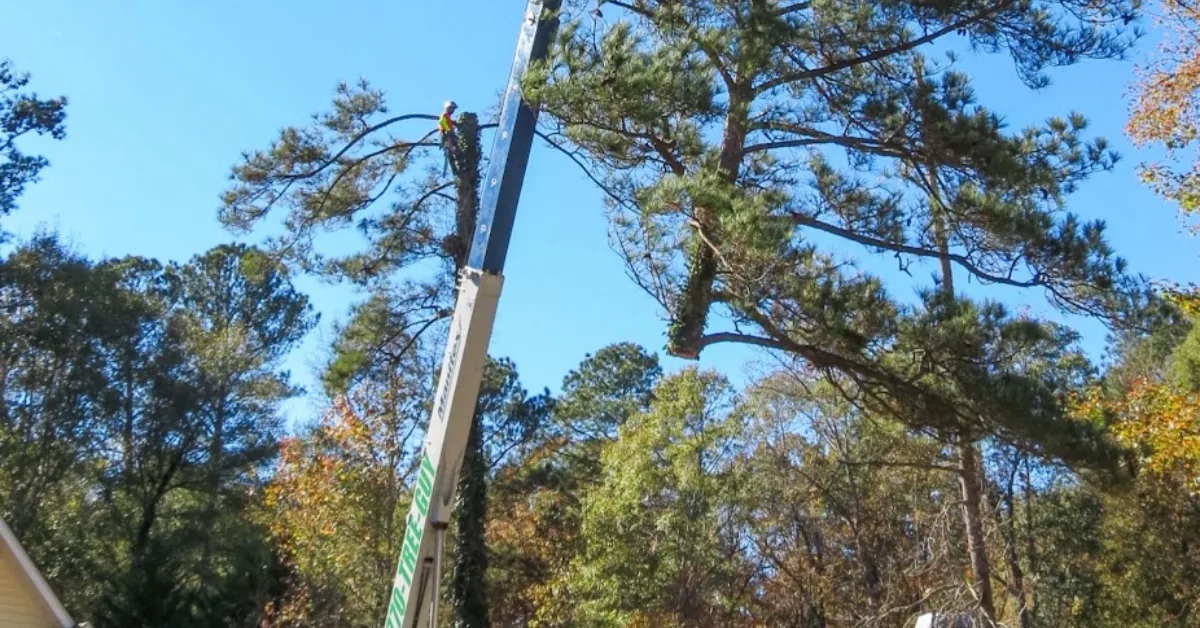
- Crane removal when it’s safer, using our 40-ton crane and spider lifts for tight access.
- Ground protection mats on soft or landscaped yards.
- Cleanup: grapple trucks and a chipper, debris gone the same day.
- Stump handling: ground below grade, or left for firewood. See stump grinding.
Cost Factors: What Actually Drives the Price
No company can quote a fair price without seeing the tree. Cost depends on size, species and wood density, access, proximity to structures and power lines, condition, and whether stump grinding and haul-away are included. You get a written, itemized estimate first. New customers get 10% off any non-emergency service over $1,000 (not combinable), or $100 off same-day hire over $2,500 (combinable). Financing, military, and senior discounts* are available.
* The discount must be mentioned at the time of the estimate and quote.
Emergency Removal: 24/7 Storm Response Across South Metro Atlanta
Yes, with immediate dispatch for hazardous, crane-assisted removals. If a tree just came down, call your utility first if lines are down, and stay clear until it’s confirmed safe. We dispatch day or night, bill your insurer directly, and require no money up front on emergency claims, documenting everything with photos for your adjuster. Full details on our emergency tree service page.
The Free Estimate: What to Expect
- Assessment: We walk the property and discuss your concerns.
- Evaluation: an ISA Certified Arborist checks stability and hazards.
- Planning: safest method, accounting for structures and utilities.
- Written estimate: itemized, no surprise line items.
- Scheduling: convenient time, right equipment on-site.
- Cleanup: full debris removal, property left clean.
Local Tree Species: What Fails and Why
- Oaks hide internal decay under heavy canopies common near downtown Newnan and Fayetteville.
- Loblolly and shortleaf pine lean or uproot fastest in saturated clay and carry southern pine beetle risk.
- Sweetgum adds heavy limb load during ice events.
- Southern magnolia holds wind load year-round as an evergreen.
- River birch develops include bark at multi-trunk unions that can fail with little warning.
- Red maple and tulip poplar grow tall and top-heavy fast, common candidates after storm damage.
Permits: Do You Need One in South Metro Atlanta?
It depends on the city or county. Newnan, Fayetteville, Peachtree City, and unincorporated Coweta and Fayette counties handle permitting differently, and some protect certain species or set a trunk-diameter threshold. Fayette County’s rules are in its Code of Ordinances. We confirm permit needs at the estimate and often handle the paperwork.
Why South Metro Atlanta Property Owners Choose 770-Tree-Guy
- 16 years in business, crew experience to 2004
- Two ISA Certified Arborists, ISA Tree Risk Assessment Qualification
- TCIA accredited, NCCCO certified crane operators
- Family-owned, fully licensed and insured
- 24/7 emergency service, no money up front on claims
- BBB accredited, A+ rated; financing, military, and senior discounts (The discount must be mentioned at the time of the estimate and quote.)
Service Area: Cities and Counties We Cover
Counties: Coweta, Fayette, with service into Clayton County.
Cities: Sharpsburg, Newnan, Peachtree City, Fayetteville, Senoia, Tyrone, Brooks, Palmetto, Jonesboro, Riverdale.
Landmarks: Trilith Studios, the Fayette County Courthouse and Main Street Square, Kenwood Park, and downtown Newnan.
See our Fayetteville tree removal page for city-specific details. Not sure you’re covered? Call (770) 373-4438
Schedule Tree Removal: Next Steps
Professional removal protects your family, property, and neighbors from a hazard that rarely gets safer by waiting. From storm response in Newnan to a declining oak in Fayetteville, 770-Tree-Guy delivers safe, documented, insured work backed by real certifications.
Call (770) 373-4438 today, or request your free estimate online.
770-Tree-Guy | Licensed and Insured Tree Removal Across South Metro Atlanta | ISA Certified Arborists | BBB Accredited A+ Rated 269 Short Rd, Sharpsburg, GA 30277 | 320 W. Lanier Avenue, Fayetteville, GA 30214